Difference between revisions of "Labarum"
m (→Origins) |
m (→Historical Evidence for Use of the Labarum) |
||
| Line 37: | Line 37: | ||
==Historical Evidence for Use of the Labarum== | ==Historical Evidence for Use of the Labarum== | ||
[[Image:Maiorina-Vetranio-siscia RIC 281.jpg|right|thumb|Coin of [[w:Vetranio|Vetranio]]; (ca.350); a soldier is holding two labara. Interestingly they differ from the labarum of Constantine in having the Chi-Rho depicted on the cloth rather than above it, having their staves decorated with [[w:Phalera (military decoration)|phalerae]] as were earlier Roman military unit standards.]] | [[Image:Maiorina-Vetranio-siscia RIC 281.jpg|right|thumb|Coin of [[w:Vetranio|Vetranio]]; (ca.350); a soldier is holding two labara. Interestingly they differ from the labarum of Constantine in having the Chi-Rho depicted on the cloth rather than above it, having their staves decorated with [[w:Phalera (military decoration)|phalerae]] as were earlier Roman military unit standards.]] | ||
| − | Historians contend that | + | Historians contend that the accounts of Lactantius and Eusebius can hardly be reconciled with each other, though they have been merged in popular notion into Constantine seeing the Chi-Rho sign on the evening before the battle. |
There is no certain evidence of the use of the letters chi and rho as a Christian sign before [[Constantine the Great|Constantine]]. Its first appearance is on a Constantinian silver coin from ca. 317, which proves that Constantine did use the sign at that time, though not very prominently.<ref>Smith, 104: "What little evidence exists suggests that in fact the labarum bearing the chi-rho symbol was not used before 317, when Crispus became Caesar..."</ref> He made extensive use of the Chi-Rho and the labarum only later in the conflict with Licinius. | There is no certain evidence of the use of the letters chi and rho as a Christian sign before [[Constantine the Great|Constantine]]. Its first appearance is on a Constantinian silver coin from ca. 317, which proves that Constantine did use the sign at that time, though not very prominently.<ref>Smith, 104: "What little evidence exists suggests that in fact the labarum bearing the chi-rho symbol was not used before 317, when Crispus became Caesar..."</ref> He made extensive use of the Chi-Rho and the labarum only later in the conflict with Licinius. | ||
| Line 45: | Line 45: | ||
Eusebius stated that in addition to the singular labarum of Constantine, other similar standards (labara) were issued to the Roman army. This is confirmed by the two labara depicted being held by a soldier on a coin of [[w:Vetranio|Vetranio]] dating from 350. | Eusebius stated that in addition to the singular labarum of Constantine, other similar standards (labara) were issued to the Roman army. This is confirmed by the two labara depicted being held by a soldier on a coin of [[w:Vetranio|Vetranio]] dating from 350. | ||
| − | The Labarum marked with the monogram of [[Christ]] is seen on coins of Constantine the Great, also of Constans, of Jovianus, and of Valentinianus, to the end of the [http://www.forumancientcoins.com/numiswiki/view.asp?key=Imperial%20Series imperial series]. | + | The Labarum marked with the monogram of [[Christ]] is seen on coins of Constantine the Great, also of Constans, of Jovianus, and of Valentinianus, to the end of the [http://www.forumancientcoins.com/numiswiki/view.asp?key=Imperial%20Series imperial series].<ref>''[http://www.forumancientcoins.com/numiswiki/view.asp?key=labarum Labarum].'' '''Numiswiki: The Collaborative Numismatics Project.'''</ref> |
==Later Usage== | ==Later Usage== | ||
Revision as of 17:52, March 6, 2010

The Labarum (Greek: λάβαρον / láboron) was a Christian imperial standard employing the sacred "Chi-Rho" Christogram, which was one of the earliest forms of christogram used by Christians. It was adopted by Roman emperor Saint Constantine the Great after receiving his celestial vision and dream, on the eve of his victory at the Milvian Bridge in 313 AD.
The Labarum of Constantine the Great was a vexillum[note 1] that displayed the "Chi-Rho" Christogram, formed from the first two Greek letters of the word "Christ" (Greek: ΧΡΙΣΤΟΣ, or Χριστός) — Chi (χ) and Rho (ρ). Fashioned after legionary standards, it substituted the from of a cross for the old pagan symbols, surmounted by a jewelled wreath containing the monogram of Christ, intersecting Chi (χ) and Rho (ρ), on which hung a purple banner with gold trim, inscribed with "Εν Τουτω Νικα" (in hoc signo vinces) — "In this sign, conquer."
As a new focal point for Roman unity, the monogram appeared on coins, shields, and later public buildings and churches.[1] From 324 the Labarum with the "Chi-Rho" Christogram was the official standard of the Roman Empire.
Contents
Origins
The Labarum was originally a Roman military ensign,[note 2] which is described to have been a more distinguished form of the Vexillum, or cavalry standard. Like the other standards, it was an object of religious veneration amongst the soldiers, who paid it divine honours. As an imperial standard, the labarum was only hoisted when the Emperor was with the army.
Etymology
The etymology of the word labarum is uncertain, however it has been suggested that the word descended from the Greek láboron (λάβαρον - laurel-leaf standard),[note 3] which in turn renders the Latin Laureum Vexillum, literally "laureled standard".[2][3][4]
In a similar but slightly different conclusion, the American Heritage Dictionary of the English Language (4th ed.) states that labarum is Late Latin, probably being an alteration of the Greek labraton ("laurel-leaf standard"), which is itself derived from the Latin Laureatum (the neuter of Laureatus - "crowned/adorned with laurel").[5]
It may also be derived from the Latin /labāre/ 'to totter, to waver', in the sense of the "waving" of a flag in the breeze.
Other proposals include a derivation from the Celtic llafar ("eloquent"), or from the ancient Cantabri dialect labaro ('four heads'),[note 4] an ancient Celtic symbol taken by the Legions during the Cantabrian Wars.
Vision of Constantine

It is commonly stated that on the evening of October 27, 312, with his army preparing for the Battle of the Milvian Bridge, the emperor Constantine I had a vision which led him to fight under the protection of the Christian God. The details of that vision, however, differ between the sources reporting it, namely Lactantius and Eusebius.
Lactantius states[6] that, in the night before the battle, Constantine was commanded in a dream to "delineate the heavenly sign on the shields of his soldiers". He obeyed and marked the shields with a sign "denoting Christ". Lactantius describes that sign as a "staurogram", or a Latin cross with its upper end rounded in a P-like fashion. There is no certain evidence that Constantine ever used that sign, rather than the better known Chi-Rho sign described by Eusebius of Caesarea.
From Eusebius, two accounts of the battle survive. The first, shorter one in the Ecclesiastical History leaves no doubt that God helped Constantine but doesn't mention any vision. In his later Life of Constantine, Eusebius gives a detailed account of a vision and stresses that he had heard the story from the emperor himself. According to this version, Constantine with his army was marching somewhere[note 5] when he looked up to the sun and saw a cross of light above it, and with it the Greek words: "Εν Τουτω Νικα" (Latin: in hoc signo vinces — "In this sign, conquer"). At first he was unsure of the meaning of the apparition, but the following night he had a dream in which Christ explained to him that he should use the sign against his enemies. Eusebius then continues to describe the labarum, the military standard used by Constantine in his later wars against Licinius, showing the Chi-Rho sign.[7]
Eusebius' Description of the Labarum

"A Description of the Standard of the Cross, which the Romans now call the Labarum."
"Now it was made in the following manner. A long spear, overlaid with gold, formed the figure of the cross by means of a transverse bar laid over it. On the top of the whole was fixed a wreath of gold and precious stones; and within this, the symbol of the Saviour’s name, two letters indicating the name of Christ by means of its initial characters, the letter P being intersected by X in its centre: and these letters the emperor was in the habit of wearing on his helmet at a later period. From the cross-bar of the spear was suspended a cloth, a royal piece, covered with a profuse embroidery of most brilliant precious stones; and which, being also richly interlaced with gold, presented an indescribable degree of beauty to the beholder. This banner was of a square form, and the upright staff, whose lower section was of great length, of the pious emperor and his children on its upper part, beneath the trophy of the cross, and immediately above the embroidered banner." "The emperor constantly made use of this sign of salvation as a safeguard against every adverse and hostile power, and commanded that others similar to it should be carried at the head of all his armies."[8]
Historical Evidence for Use of the Labarum

Historians contend that the accounts of Lactantius and Eusebius can hardly be reconciled with each other, though they have been merged in popular notion into Constantine seeing the Chi-Rho sign on the evening before the battle.
There is no certain evidence of the use of the letters chi and rho as a Christian sign before Constantine. Its first appearance is on a Constantinian silver coin from ca. 317, which proves that Constantine did use the sign at that time, though not very prominently.[9] He made extensive use of the Chi-Rho and the labarum only later in the conflict with Licinius.
In the course of Constantine's second war against Licinius in 324, the latter developed a superstitious dread of Constantine's standard. During the attack of Constantine's troops at the Battle of Adrianople the guard of the labarum standard were directed to move it to any part of the field where his soldiers seemed to be faltering. The appearance of this talismanic object appeared to embolden Constantine's troops and dismay those of Licinius.[10] At the final battle of the war, the Battle of Chrysopolis, Licinius, though prominently displaying the images of Rome's pagan pantheon on his own battle line, forbade his troops from actively attacking the labarum, or even looking at it directly.[11]
Eusebius stated that in addition to the singular labarum of Constantine, other similar standards (labara) were issued to the Roman army. This is confirmed by the two labara depicted being held by a soldier on a coin of Vetranio dating from 350.
The Labarum marked with the monogram of Christ is seen on coins of Constantine the Great, also of Constans, of Jovianus, and of Valentinianus, to the end of the imperial series.[12]
Later Usage
Later usage has sometimes regarded the terms "labarum" and "Chi-Rho" as synonyms (i.e. the labarum bearing the chi-rho symbol). Ancient sources however draw an unambiguous distinction between the two, as the "Chi-Rho" Christogram and the "Labarum" were not originally synonyms; originally, the labarum being a type of vexillum, was a military standard used in the Classical Era of the Roman Empire, with a flag hanging from a horizontal crossbar; the Chi-Rho Christogram was only added to the flag by the Emperor Constantine I in the late Roman period.
In addition, the "Chi-Rho" Christogram was not always used is connection with the imperial labarum, but its use by Christians naturally evolved into a variety of formats, including its use on coins and medallions (minted during Constantine's reign and by subsequent rulers), on Christian sarcophagi and frescoes from about 350 AD, and became part of the official imperial insignia after Constantine, eventually appearing on public buildings and churches as well.
A later Byzantine manuscript indicates that a jewelled labarum standard believed to have been that of Constantine was preserved for centuries, as an object of great veneration, in the imperial treasury at Constantinople.[13] The labarum, with minor variations in its form, was widely used by the Christian Roman emperors who followed Constantine I.
A miniature version of the labarum became part of the imperial regalia of Byzantine rulers, who were often depicted carrying it in their right hands.
In the Middle Ages the pastoral staff of a bishop often had attached to it a small purple scarf known as the vexillum, supposedly derived from the labarum.[14]
In Greece, the "Holy Lavara" were a set of early national Greek flags, blessed by the Greek Orthodox Church. Under these banners the Greeks united throughout the Greek War of Independence (1821-32), a war of liberation waged against the Ottoman Empire.[note 6]
Today, the term "labarum" is generally used for any ecclesiastical banner, such as those carried in religious processions.
Gallery
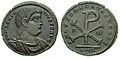
Coin of Magnentius (350-353 AD) with a large Chi-Rho, showing the first apparent use of the Alpha and Omega flanking the Christogram.
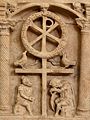
Anastasis, symbolic representation of the resurrection of Christ, (Sarcophagus, ca. 350 AD).
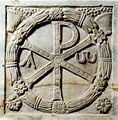
Monogram of Christ, with the Alpha and Omega symbols as part of the Chi-Rho monogram (Museo Pio Cristiano, Vatican, undated).
- San Vitale in Ravenna.jpg
Mosaic of Emperor Justinian with his retinue, with the Labarum displayed on a soldier's shield. (Ravenna, before 547 AD).
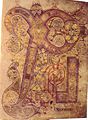
The Book of Kells, Folio 34r, containing the Chi-Rho Monogram (ca. 800 AD).
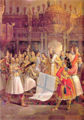
Bp. Germanos of Old Patras blessing the Greek banner at Agia Lavra monastery, 25 March 1821.
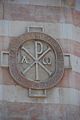
Standard on a Russian monastery, Jerusalem, Israel.
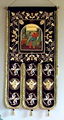
A modern Orthodox ecclesiastical standard (Labarum), with an icon.


See also
Notes
- ↑ The vexillum (plural vexilla) was a military standard (flag, banner) used in the Classical Era of the Roman Empire. In the vexillum the cloth was draped from a horizontal crossbar suspended from the staff; this is unlike most modern flags in which the 'hoist' of the cloth is attached directly to the vertical staff. The bearer of a vexillum was known as a vexillarius. The vexillum was a treasured symbol of the military unit that it represented and it was closely defended in combat.
- ↑ That the Labarum dated its designation as the imperial standard from an early period of the empire, is a supposition confirmed by a colonial medal of Tiberius (dedicated to that Prince by Caesarea-Augusta (Saragozza)), on which may be remarked the form of that ensign. The Labarum is found in the left hand of emperors; on some military figures; and on coins of Nero, Domitian, Trajan, Hadrian, Antoninus Pius, Marcus Aurelius, Commodus, Septimius Severus, and other princes anterior to Constantine. A vexillum or cavalry standard, resembling the Labarum, appears on several colonial coins, such as those from Acci, Antiochia Pisidiae, and Caesarea-Augusta. (Labarum. Numiswiki: The Collaborative Numismatics Project.)
- ↑ The similar Greek term "Lavra" has a different etymology. In Orthodox Christianity and certain other Eastern Christian communities Lavra or Laura (Greek: Λαύρα; Cyrillic: Ла́вра) originally meant a cluster of cells or caves for hermits, with a church and sometimes a refectory at the center (for example, Agia Lavra monastery in Greece). The term originates from Ancient Greek, where it means "a passage" or "an alley".
- ↑ In modern Basque the word is lauburu, with the same meaning.
- ↑ Eusebius doesn't specify the actual location of the event, but it clearly isn't in the camp at Rome.
- ↑ The blessing of the standards recalls Constantine's use of the Labarum with the Chi-Rho Christogram before his battle with Maxentius at the Milvian Bridge, just over 1500 years earlier.
References
- ↑ -----. "Labarum." In: J.D. Douglas and Earle E. Cairns (Eds.). The New International Dictionary of the Christian Church. 2nd ed.. Zondervan Publishing House, 1996. p.575.
- ↑ H. Grégoire, "L'étymologie de 'Labarum'" Byzantion 4 (1929:477-82).
- ↑ Kahane, Drs. Henry & Renée. "Contributions by Byzantinologists to Romance Etymology." RLiR, XXVI (1962), 126-39.
- ↑ Kazhdan, Alexander, ed.. Oxford Dictionary of Byzantium. Oxford University Press, 1991. p.1167.
- ↑ "Labarum". The American Heritage® Dictionary of the English Language, Fourth Edition, copyright ©2000 by Houghton Mifflin Company. Updated in 2009. Published by Houghton Mifflin Company.
- ↑ Lactantius, On the Deaths of the Persecutors, chapter 44.5.
- ↑ Gerberding and Moran Cruz, 55; cf. Eusebius, Life of Constantine.
- ↑ Eusebius Pamphilius: Church History, Life of Constantine, Oration in Praise of Constantine, Chapter XXXI.
- ↑ Smith, 104: "What little evidence exists suggests that in fact the labarum bearing the chi-rho symbol was not used before 317, when Crispus became Caesar..."
- ↑ Odahl, p. 178.
- ↑ Odahl, p.180
- ↑ Labarum. Numiswiki: The Collaborative Numismatics Project.
- ↑ Lieu and Montserrat p. 118. From a Byzantine life of Constantine (BHG 364) written in the mid to late ninth century.
- ↑ "Labarum." Encyclopædia Britannica. Encyclopædia Britannica 2009 Ultimate Reference Suite. Chicago: Encyclopædia Britannica, 2009.
Sources
- -----. "Labarum." In: J.D. Douglas and Earle E. Cairns (Eds.). The New International Dictionary of the Christian Church. 2nd ed.. Zondervan Publishing House, 1996. p.575.
- -----. "Labarum". The American Heritage® Dictionary of the English Language, Fourth Edition, copyright ©2000 by Houghton Mifflin Company. Updated in 2009. Published by Houghton Mifflin Company.
- -----. "Labarum." Encyclopædia Britannica. Encyclopædia Britannica 2009 Ultimate Reference Suite. Chicago: Encyclopædia Britannica, 2009.
- Grant, Michael. The Emperor Constantine. London, 1993.
- Hassett, Maurice. "Labarum (Chi-Rho)." The Catholic Encyclopedia (New Advent). Vol. 8. New York: Robert Appleton Company, 1910. 4 Mar. 2010.
- Kazhdan, Alexander, ed.. Oxford Dictionary of Byzantium. Oxford University Press, 1991. p.1167. ISBN 978-0-19-504652-6
- Labarum. Wikipedia.
- Labarum. Numiswiki: The Collaborative Numismatics Project.
- Lieu, S.N.C and Montserrat, D. (Eds.). From Constantine to Julian. London, 1996.
- Odahl, C.M. Constantine and the Christian Empire. Routledge 2004.
- Smith, J.H. Constantine the Great. Hamilton, 1971.
- Smith, Sir William and Samuel Cheetham (eds.). "Labarum." A dictionary of Christian antiquities: Being a continuation of the ʻDictionary of the Bible', Volume 2. J. B. Burr, 1880. pp.908-911.
External Links
Wikipedia
Other
